


The Mandate for Transformation: Why Traditional Compliance Fails
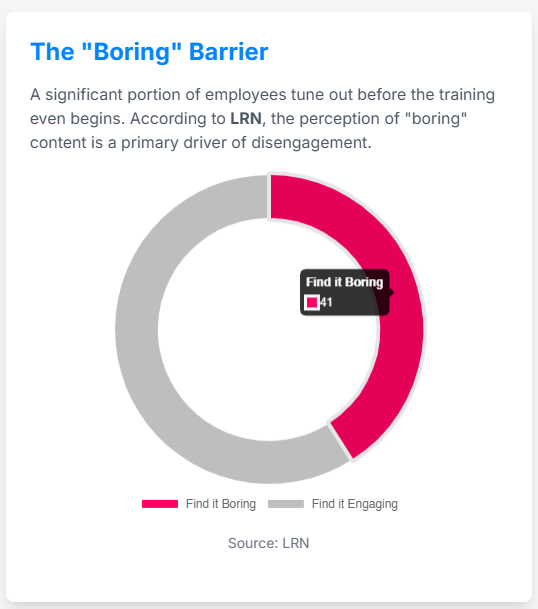
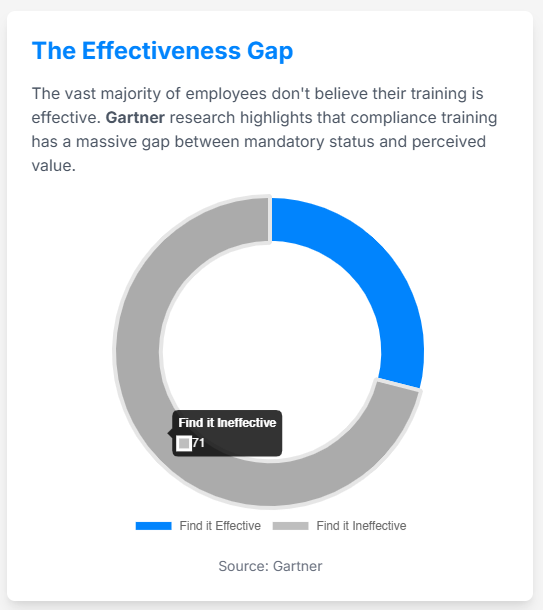
Compliance training has long suffered from a profound engagement deficit. It is often treated as a perfunctory, mandatory requirement that employees simply “check the box” on, resulting in passive, ineffective learning. This inadequacy carries a quantifiable and substantial cost. Low engagement leads to persistent knowledge gaps and reduced employee confidence in ethical reporting, creating significant financial exposure. In one instance, the U.S. Securities and Exchange Commission (SEC) issued a hefty $2.03 million fine because a firm’s compliance program controls were deemed inadequate, proving that regulatory scrutiny is focused not just on the existence of training, but its effectiveness.
The core issue lies in the delivery. Traditional methods suffer from the "monologue problem", content delivered via long, monotone presentations or endless policy slides. This passive approach is the enemy of retention and is quickly lost on an audience, especially when training ignores the practical challenges employees face in their day-to-day roles.
Part I: Contextualization and the Shift to Modern Learning
To overcome this, organizations must pivot from passive delivery to active learning, a shift guided by Adult Learning Principles (Andragogy). Adults are self-directed and motivated by immediate relevance. Training must be goal-oriented, task-based, and immediately applicable to their work.
Anchoring Rules in Reality: Storytelling and Scenarios
Abstract rules are easily forgotten, but stories stick. Studies show people remember information conveyed through stories up to 22 times more effectively than standalone facts. Compliance narratives must use an authentic voice , feature relatable characters , and present genuine dilemmas that mirror the complex pressures employees face in the real world, such as bending expense rules for a sale or dealing with a colleague's inappropriate jokes.
This narrative approach is best delivered through Scenario-Based Learning (SBL). SBL places learners in simulated, real-world situations, forcing them to make critical decisions and analyze the consequences in a safe, controlled environment. For complex topics, branching scenarios simulate high-stakes decision-making with multiple variables, such as navigating conflicts of interest or handling misconduct reports.
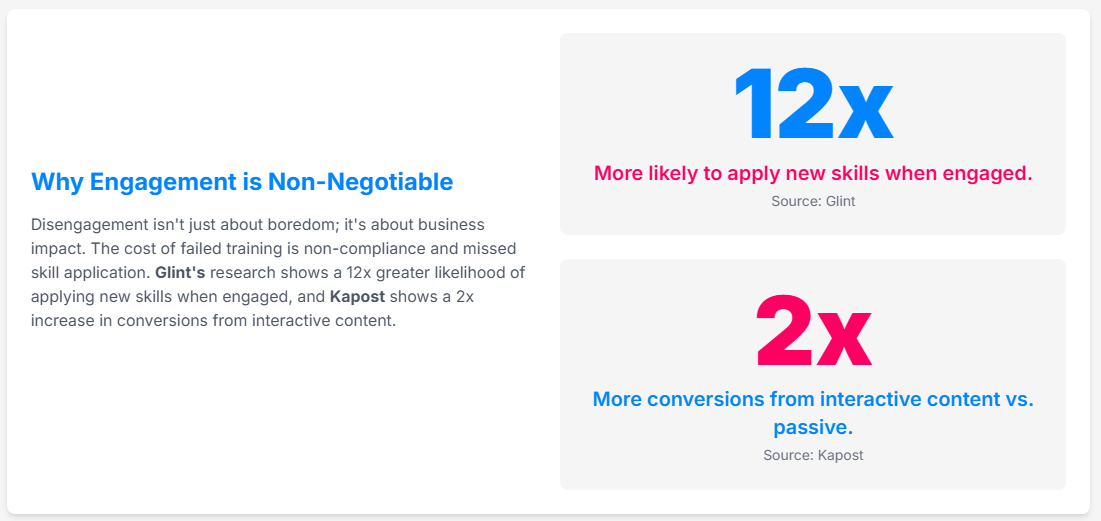
Crucially, the goal shifts from measuring rote policy recall to measuring critical thinking and demonstrated judgment. Organizations that make this switch have reported measurable improvement in policy adherence and reductions in compliance violations and legal incidents.
Reinforcement: The Necessity of Microlearning and Adaptive Tech
The annual compliance training model is critically insufficient due to the "Forgetting Curve". Microlearning is the essential remedy: short, focused learning bursts that reinforce good decision-making year-round. Microlearning is not only highly efficient (reducing development costs by 50% and increasing development speed by 300%) but also combats training fatigue and can be delivered exactly where employees need it.
This is amplified by Adaptive Learning technology, which utilizes AI to deliver personalized experiences. These systems continuously assess an employee's progress and adjust the difficulty and focus of training in real-time. This tailoring ensures that content is highly relevant; for example, finance employees see anti-fraud scenarios, while HR teams focus on harassment prevention, making the content up to 50% more relevant to their specific roles.
Part II: The Live Engagement Engine: A Solution for VILT
While personalized e-learning manages policy review, Virtual Instructor-Led Training (VILT) remains crucial for handling nuanced ethical topics. The human connection in VILT is vital, allowing participants to ask questions, engage in discussions, and receive immediate, personalized feedback.
However, VILT is highly susceptible to the same passive engagement deficits that plague e-learning. To transform VILT from a monologue into a dynamic, active learning environment, organizations must integrate specialized interaction technologies.
StreamAlive: Turning the Chat into a Dialogue
To overcome the passivity trap, tools that facilitate low-friction, high-impact interaction are required. This is where a solution like StreamAlive becomes the compliance team’s most powerful ally.
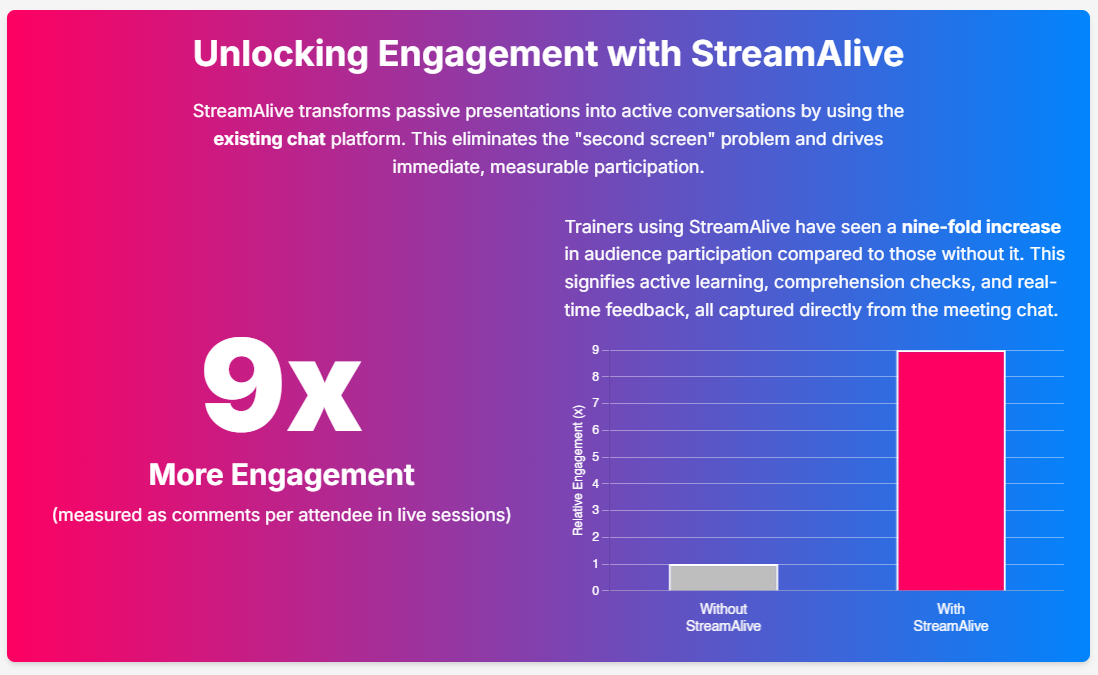
StreamAlive’s core strength is its ability to leverage the existing live meeting chat stream (on platforms like Zoom, Teams, or Google Meet). Participation has a zero learning curve for the employee, they simply type in the chat. This dramatically breaks the monotony and facilitates a genuine dialogue.
The Impact is Immediate and Measurable:
- 9x More Engagement: Trainers leveraging these technologies have seen up to 9x more engagement (counted as comments per attendee) in their sessions compared to those without such interactive integration.
- AI-Powered Content Creation: To remove the burden on instructors, StreamAlive’s AI can instantly generate dozens of relevant interactions, quizzes, and discussion prompts directly from the training material. This "jolt ⚡️ of energy" is perfect for traditionally dry topics like Know Your Customer (KYC) or Anti-Money Laundering (AML).
- Real-Time Accountability: The platform provides a critical layer of accountability by tracking individual learner participation in real-time, often using leaderboards, and providing detailed post-event analytics. This real-time tracking allows the instructor to identify passive listeners immediately, transforming the session from a mere attendance registry into an active learning environment where engagement is measured and accountability is assured.
- Gamification and Motivation: By instantly deploying quizzes and leaderboards, tools like StreamAlive tap into the human desire for competition and recognition. Gamification stimulates positive emotions like excitement and anticipation, increasing attention, effort, motivation, and satisfaction. (Though competitive elements must be managed to ensure they don't undermine psychological safety).
Part III: Measuring Real Effectiveness and ROI
The effectiveness of this modern, engaging approach must be validated by measurable Return on Investment (ROI).

The net benefits are quantified by the reduction of negative outcomes (like fines and litigation) and the increase in positive outcomes (like team productivity).
Modern programs must shift from lagging indicators (like completion rates) to leading indicators that measure organizational impact and cultural maturity. This includes:
- Tangible Business Impact: High-engagement programs deliver reduced employee error rates and, most critically, a reduction in compliance violations and legal incidents. Using agile content systems, content update cycles can drop from weeks to hours.
- Cultural Maturity: The most profound measure is cultural maturation. Effective training correlates directly with increased employee confidence in reporting ethical concerns. A strong, just culture is indicated by an increase in incident and near-miss reporting rates, suggesting that employees feel safe to abandon blame and report issues for systemic improvement. Studies show a significant correlation between effective workshops and increased reporting volume.
By integrating performance data from adaptive learning with granular engagement metrics from live platforms (like StreamAlive), organizations transition from reactive processes to predictive risk management. AI systems can analyze past patterns and forecast potential risks weeks ahead, allowing the organization to preemptively address potential issues, shifting the focus decisively from remediation to prevention.
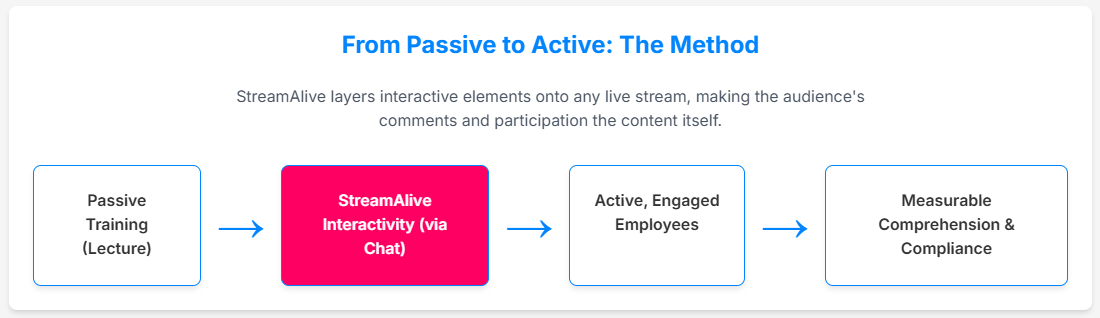
The transformation of compliance training is not optional; it is a regulatory and financial imperative. By committing to engagement through realistic content, personalized delivery, and, critically, high-impact live interaction tools like StreamAlive, organizations move compliance from a grudging obligation to a dynamic, data-driven system. When every employee is an active, accountable participant, the compliance program becomes a strategically managed competitive advantage.


.svg.png)


